Polly Put The Kettle On Play video

Polly Put The Kettle On

Bring tradition to life with 'Polly Put The Kettle On' by Love to Sing Ð a classic nursery rhyme that supports language development and rhythm awareness in young... read more

Polly Put The Kettle On Lyrics

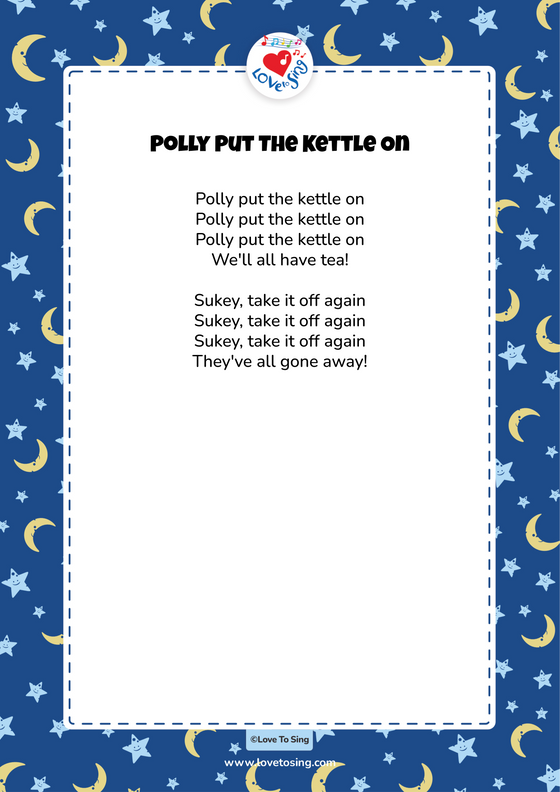
Polly put the kettle on
We'll all have tea!

Sukey, take it off again
They've all gone away!

Polly Put The Kettle On

Get Free Lyric Sheet PDF

Login to download any lyric sheet without having to re-enter your email.

Download

About Polly Put The Kettle On

Released on: July 24, 2023

00 mins 33 sec

Bring tradition to life with 'Polly Put The Kettle On' by Love to Sing Ð a classic nursery rhyme that supports language development and rhythm awareness in young learners.

Perfect for circle time or bedtime routines, this song helps children improve memory, pronunciation, and listening skills. Educators can integrate it into literacy activities, while parents can use it to create comforting, musical moments at home.

Polly Put The Kettle On Song Activities

Music
Listen to the song. Ask children if they can whistle?
Play the song again and ask children to whistle along to the "kettle whistle sound" in the song.
Find "whistle sound sources" e.g. blow up a balloon half way, pinch the sides and let the air escape; steam train whistle; use a thick blade of grass - split down the middle and blow through. Let us know what other "whistle sound sources" you can find?

Science
Find out why kettles whistle?

Dance
Children choose a word to describe the movement of steam e.g. rise, evaporate, hot etc. and practice different ways of dancing these moves individually and in groups.

Literacy
Sing and read along to the YouTube song to achieve multi-sensory learning "Do it, see it and hear it!"
Print out the song PDF
Read the song lyrics - ask children a variety of questions.
Re-read the song lyrics and ask children to join in.
Recognise and use a variety of punctuation when reading. " " ! ? . ,
Look at print and conventions (bold, italics).
Talk about interesting/challenging words and discuss what they mean.
Word study - phonic knowledge, compound words, rhyming word, contractions etc.